 |
|
|
 |
|
Friday, 15th May 2026 |
|
Here's something that might surprise you.
Right now, AI agents are visiting e-commerce websites. Browsing products. Filling out forms. Comparing prices. Completing checkouts on behalf of real people who asked them to.
So how does this affect you?
Keep reading to find out. |
|
|
|
How It Affects You |
|
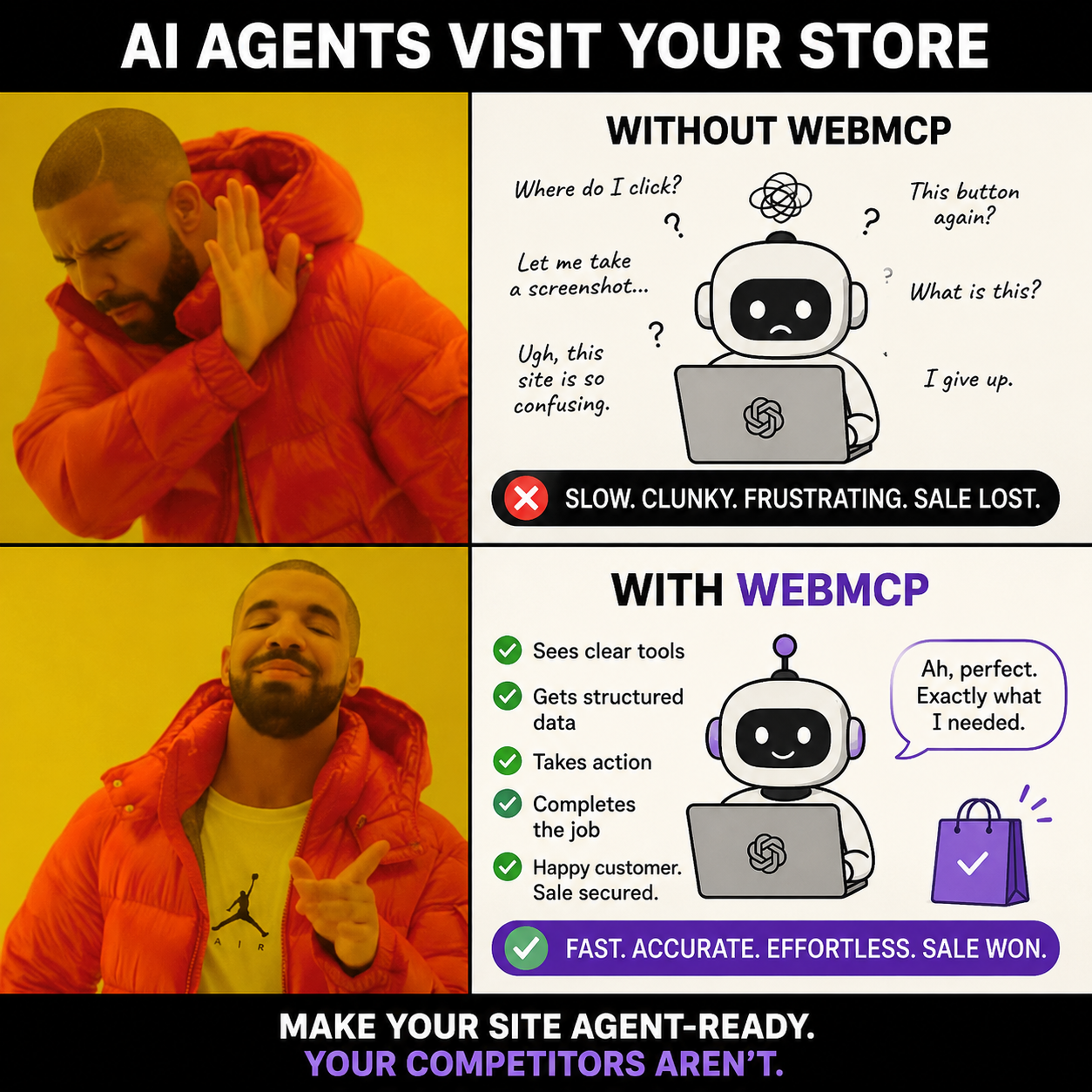
When an AI agent visits a website that wasn't built with it in mind, it does something: it takes screenshots.
It tries to guess where to click. It scrapes whatever text it can find in your site's code and pieces together what your website does.
It's slow. It breaks constantly. And every time you update your design or move a button, the whole thing falls apart again.
There's now a better way. It's called WebMCP, and if you run an ecommerce brand, this is one of the most important things you can learn about right now.
|
|
|
What Actually Is WebMCP?
|
|
WebMCP stands for Web Model Context Protocol. In plain English, it's a way for your website to speak directly to AI agents, instead of making them guess.
Think about it this way. Right now, when an AI agent visits your store, it's like sending someone into a shop with no signage, no staff, and all the products locked in boxes. They can eventually figure out what's there, but it takes forever, and they'll probably give up halfway through.
WebMCP is the equivalent of giving that visitor a clear map, a staff member who speaks their language, and a direct line to every product, form, and action on your site. You define exactly what your website can do. The agent calls the right tool. The job gets done fast and accurately every time.
It was built by engineers at Google and Microsoft and is being developed as an official web standard. It launched as an early preview in February 2026.
|
|
|
|
Why This Specifically for Ecommerce Brands |
|
Imagine a customer asks their AI assistant to find a vitamin C serum under $40 with good reviews, and the assistant adds the best option to the cart.
That agent goes out and visits several websites. On most of them, it fumbles around, takes screenshots, tries to parse product pages, and either gets it wrong or gives up entirely.
On a WebMCP-enabled store, it uses a clean, structured search tool, delivers reliable results instantly, and completes checkout without a single error.
Which store gets the sale?
That's not a hypothetical future scenario. That's the direction ecommerce is heading, and it's heading there faster than most people expect. Every billion dollars Google and Meta are pouring into AI infrastructure right now is accelerating exactly this kind of agent-driven interaction.
The infrastructure is being built. The agents are getting smarter. The only variable is whether your store is ready to receive them properly.
|
|
|
So, How Do You Make Your Site Agent-Ready?
|
|
There are two ways to implement WebMCP on your site:
1. The simple route (for standard forms and search): If your site has product search, contact forms, newsletter signups, or checkout flows, you can make them agent-readable by adding just two pieces of information to your existing HTML. A tool name and a tool description. That's it. Two small additions and your forms are now visible to AI agents as structured, callable tools.
2. The advanced route (for complex or dynamic stores): If you have a custom checkout flow, dynamic pricing, a large product catalogue with lots of variables, or any kind of complex interaction, you'll want to use the more technical implementation. It uses JavaScript to register specific tools with defined inputs and logic. It gives you full control over exactly what agents can do on your site and how. For most ecommerce brands in beauty, skincare, supplements, or apparel with more than a basic Shopify setup, this is the route worth exploring.
One practical thing to know, WebMCP currently works in Chrome's developer preview, so it's still in early stages. You can start experimenting now through Google's Early Preview Program. But even if you're not ready to implement it tomorrow, understanding what's coming and making sure your developer or tech partner is aware of it is already putting you ahead of most brands.
|
|
|
|
We Can Help You Implement These At Pro Marketer |
|
Staying ahead of these shifts and translating them into executable strategies for ecommerce brands is exactly what we're here for.
We work with brand owners who want to be ahead of the curve.
So, if you want to have a real conversation about what an AI-ready growth strategy looks like for your brand, let's talk.
We're helping ecommerce brands 3X their revenue with AI, and the window to get ahead is still open.
|
|
|
|
Was this email forwarded to you? Sign up here.
P.S. Got a question, trend, or idea you want me to cover in the next newsletter? Hit reply, I'm all ears!
|
|
|
|
|
|
Arun.K
Pro Marketer
arun@promarketer.ca |
|
|
|
|
Sent to: _t.e.s.t_@example.com
Pro Marketer, 10 Thornmount Dr, Toronto, Ontario M1B 3J4, Canada
Don't want future emails? Unsubscribe |
|
|
|
|